

Indian PIN Code Structure in India carries a small six-digit number that silently guides letters, parcels, and online deliveries to the right doorstep. This number is known as the PIN code. While most of us use it daily, very few understand how the Indian PIN Code structure actually works.
Digital India and Smart PIN Code Systems: Transforming the Way India Connects in 2026
Behind this simple code lies a well-planned system called the Indian PIN code system, designed to manage deliveries across a vast and diverse country. From busy city streets to remote villages, the Postal Index Number India system ensures accuracy, speed, and reliability.
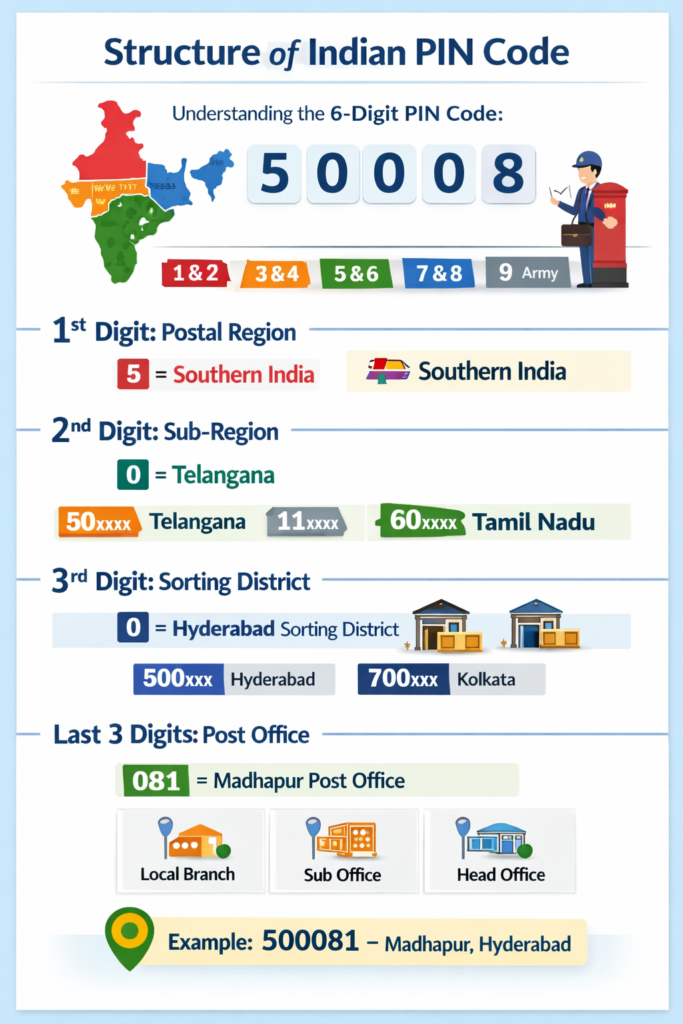
In this guide, we will explore the structure of Indian PIN codes in a clear and storytelling manner, making it easy for anyone to understand—whether you are searching for an area PIN code or learning how the system functions.
What Is a PIN Code?
A PIN code, short for Postal Index Number, is a six-digit numeric code used by India Post to identify specific geographic regions and post offices.
This system was introduced in 1972 to solve problems such as: Duplicate place names Incorrect mail routing Delays in delivery
Today, PIN codes are not limited to postal use. They are essential for: E-commerce deliveries Banking and KYC verification Government services Courier and logistics companies
In simple terms, a PIN code acts as a location fingerprint for every address in India.
Why the Indian PIN Code System Matters
India has thousands of towns and villages, many sharing similar names. Without a structured numbering system, delivering mail accurately would be nearly impossible.
The Indian PIN code system helps by: Dividing the country into logical postal zones, Reducing human error in sorting Supporting automation and digital tracking This is why entering the correct area PIN code is mandatory on most websites and forms today.
Understanding the Indian PIN Code Structure
India has thousands of towns and villages, many sharing similar names. Without a structured numbering system, delivering mail accurately would be nearly impossible.
The Indian PIN code system helps by:
Dividing the country into logical postal zones, reducing human error in sorting, supporting automation and digital tracking This is why entering the correct area PIN code is mandatory on most websites and forms today.
Understanding the Indian PIN Code Structure
An Indian PIN code consists of six digits, and each digit plays a specific role. Together, these digits narrow down a broad region into a precise delivery point.
First Digit: Postal Zone
The first digit represents one of the postal zones in India.
India is divided into
8 geographical zones
1 functional zone (Army Postal Service),
Postal Zone Overview:
1 & 2 – Northern India
3 & 4 – Western India
5 & 6 – Southern India
7 & 8 – Eastern and North-Eastern India
9 – Army Postal Service This digit helps route mail to the correct part of the country.
Second Digit:
Sub-Region The second digit identifies a sub-region within the postal zone.
These sub-regions usually align with: One state A group of states Major administrative areas This layer ensures mail moves in the right direction after reaching the main zone.
Third Digit: Sorting District , The third digit indicates a sorting district, which serves as a key mail processing hub.
Sorting districts: Receive bulk mail, Separate items for nearby areas forward them to local post offices. The first three digits together are called the sorting code, a critical part of the Indian PIN Code structure. Digits: Delivery Post Office The last three digits identify the specific post office that delivers the mail.
These digits: Distinguish between nearby localities.
Identify urban and rural delivery points Enable last-mile delivery This is the most precise part of the Postal Index Number India system.
Example of an Indian PIN Code Explained Let’s understand this with an example: 560001 5 – Southern India 6 – Karnataka sub-region 0 – Bengaluru sorting district 001 – Head Post Office In just six digits, the system identifies the exact delivery office.
Types of Post Offices Linked to PIN Codes
Each PIN code is connected to a specific type of post office. Head Post Office (HPO) Main office in a district Usually ends with 001 Sub Post Office (SPO)
Works under a head office. Handles town or locality deliveries. A Branch Post Office (BPO) serves villages and rural areas. Covers smaller populations. All these offices together support accurate area PIN code mapping.
All State PIN Code System in India Every Indian state and union territory has its own PIN code range.
This makes it easier to identify locations at a state level.
Examples :
Delhi: 110001 onwards
Maharashtra: 400001 onwards
Tamil Nadu: 600001 onwards
West Bengal: 700001 onwards
Searching all state PIN codes helps users verify addresses and plan deliveries efficiently.
How Area PIN Codes Are Assigned
Area PIN codes are assigned based on: Population density, Geographic layout, and Delivery workload. Urban areas may have multiple PIN codes, while rural regions often share one. This balance helps India Post manage resources efficiently.
Role of PIN Codes in Online Deliveries
E-commerce platforms depend heavily on PIN codes.
When you enter a PIN code:
Delivery availability is checked Courier partners are assigned Estimated delivery time is calculated. Without the Indian PIN code system, online shopping in India would not function smoothly.
Common PIN Code Mistakes to Avoid
Many delivery issues occur due to simple PIN code errors. Common mistakes include: Using an outdated PIN code Confusing district PIN with area PIN Entering the nearest city PIN instead of local one Always verify your area PIN code using a trusted PIN code website.
PIN Code vs ZIP Code:
While India uses PIN codes, some countries use ZIP codes or postal codes.
What’s the Difference?
Key difference: PIN code = 6 digits (India) ZIP code = 5 or 9 digits (USA)
The purpose remains the same location identification but the structure differs.
I very delighted to find this internet site on bing, just what I was searching for as well saved to fav